
Oqood registration in Dubai: what the off-plan register proves and when it starts to count
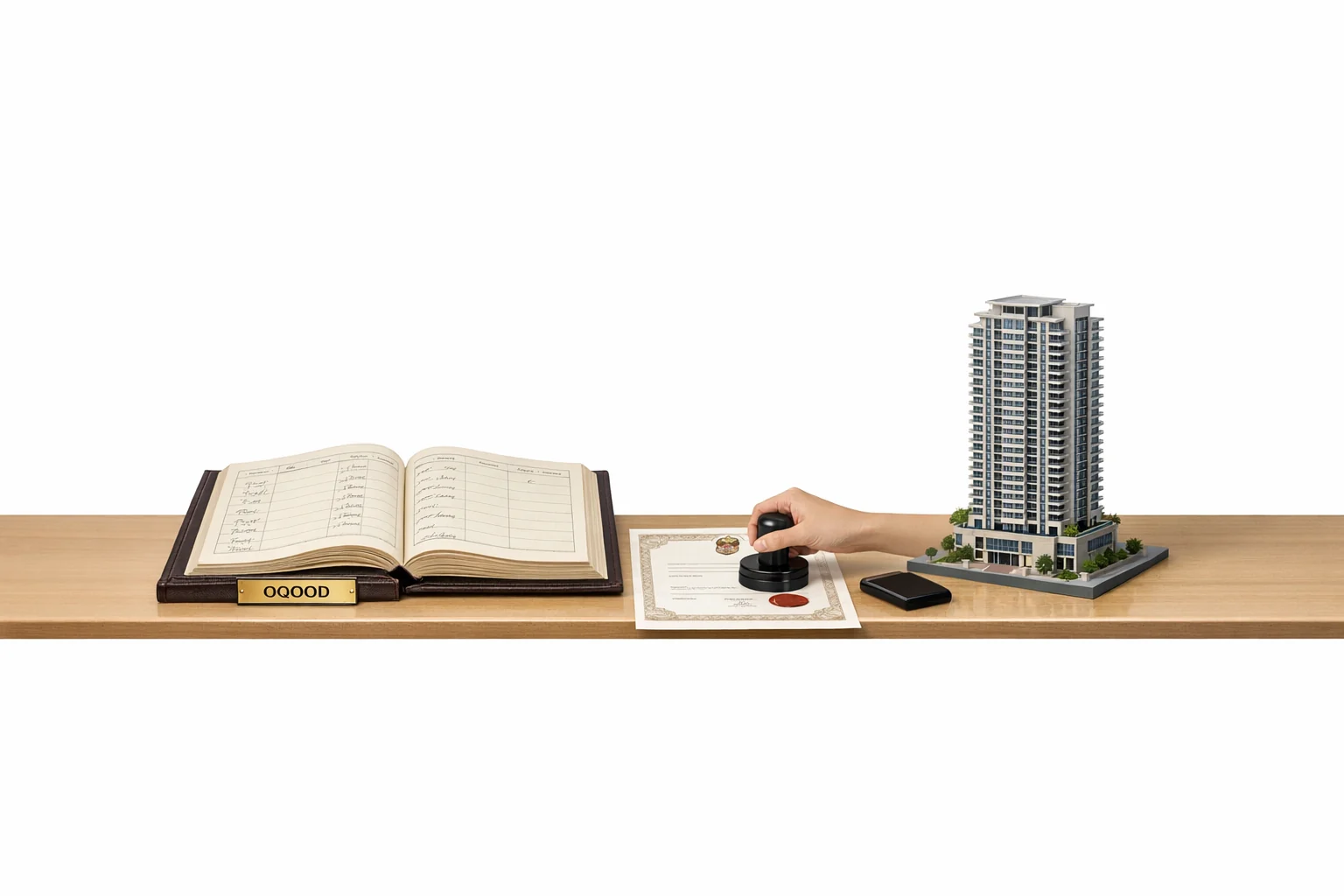
Oqood registration is the Dubai Land Department entry that records your off-plan purchase between signing the Sale and Purchase Agreement (SPA) and receiving a title deed. It is what turns a signed contract into a recorded interest in a specific unit. Under the law as Khaleej Times summarises it (Article 3(1) of Law No. 13 of 2008), a sale of this kind is void unless it is entered in the register, and the certificate that follows is issued as evidence of the buyer's rights.
Two things follow. First, an Oqood certificate is the document to ask for, not a receipt, a booking form or an email from a sales agent. Second, the market statistics you read each quarter count a sale when it is registered, not when you agree it, so the register also shapes the numbers that buyers use to judge the market. Both points are worth understanding before the first payment, not after the third.
What Oqood registration records
Oqood is the name of the digital platform, run by the Dubai Land Department (DLD) and regulated by the Real Estate Regulatory Authority (RERA), on which off-plan initial sale agreements are registered. Gulf News (last updated 1 November 2018) explains that it was established by Law No. 13 of 2008, that the developer registers the sale in the purchaser's name, and that the certificate protects the buyer's right to the unit from being sold on without their knowledge.
Registration is two-layered. The developer registers the project first, with the details, documents and financial guarantees the DLD requires, according to a HAS Law Firm note on Mondaq (14 June 2023). The buyer's details and SPA are then recorded against that project. Our reading is that a unit cannot be properly registered inside a project that is not.
According to Sotheby's International Realty, the certificate lists the unit number, project name, buyer, developer, purchase price, payment schedule and a DLD reference. That list is also your checklist. Each field should match the SPA you signed.
What you hold at each stage
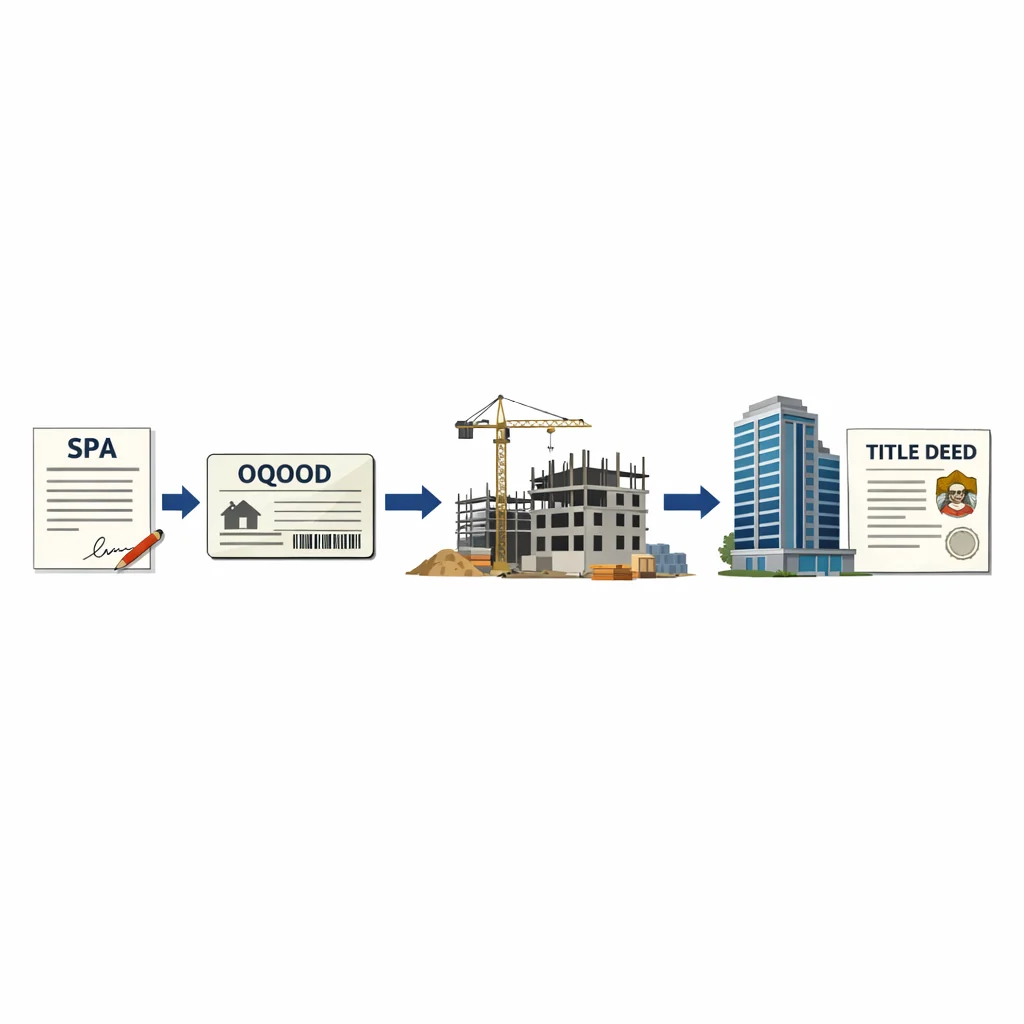
A buyer holds four different documents on the way to ownership, and they carry different weight. The table sets out what each is, based on the sources linked above.
| Stage | Document | What it establishes | Who issues it |
|---|---|---|---|
| Booking | Reservation form | A commercial arrangement to hold a unit. Not itself an entry in the register (our reading) | Developer or broker |
| Contract | Sale and Purchase Agreement | The contract: price, completion date, compensation for breach, force majeure (Khaleej Times) | Developer |
| Construction | Oqood certificate | The buyer's registered interest in the unit while it is built (Meraas, 26 January 2026) | DLD |
| After handover | Title deed | Registered ownership, the basis for resale, mortgage registration and inheritance (Meraas) | DLD |
The reservation row is our reading, not a quotation: the law as quoted ties validity to entry in the register, and none of the sources above describes a reservation form as that entry. The practical point is that the SPA creates the contract and Oqood registration records it. The two are not the same event.
When does registration happen? The sources do not agree
The most common question from buyers is how long registration takes and what has to be paid first. Published guides give different answers, and several give none.
| Source | When the entry is made | Timing stated |
|---|---|---|
| Sotheby's International Realty | After the SPA is signed and 25 per cent has been paid; elsewhere on the same page, many developers wait for 20 to 25 per cent | A few days to a couple of weeks |
| Khaleej Times legal column (17 May 2026) | After the project is registered and the buyer's details are recorded | No deadline stated |
| HAS Law Firm on Mondaq (14 June 2023) | Projects must be registered by the developer | No deadline stated |
| Meraas (26 January 2026) | Interim registration for off-plan sales | No deadline stated |
Sotheby's is a broker, and the Sotheby's page does not reconcile its own 25 per cent and 20 to 25 per cent statements. We would treat the payment threshold as something to ask the developer to state in writing, not as a settled rule. What is consistent across the sources is the direction of travel: the SPA comes first, registration follows, and the certificate arrives after it.
The cost is similar. Sotheby's puts the Oqood registration fee at 4 per cent of the purchase price, and Meraas says it "typically costs 4% of the property value, plus minor administrative charges". Both are secondary sources and neither gives the administrative amounts, so confirm the full schedule with the developer before you sign. Where a developer offers to waive the DLD fee, check whether that covers Oqood and the smaller charges too.
Why a sale can sit unregistered for weeks
For a buyer, the gap between signing and registration is the period of greatest exposure, because the contract exists but the record does not. The reasons the gap opens are mostly procedural. The developer, not the buyer, files the entry. Payment thresholds, if a developer applies one, delay the filing. And the DLD reviews what is submitted.
The same gap appears in the market data. Cavendish Maxwell's Q3 2026 analysis, published through Zawya, reports residential sales of more than AED 72.6 billion across about 34,000 transactions for the quarter ended 30 September 2026. Its Head of Residential Valuation, Ronan Arthur, is quoted saying the data "captures a mix of recent and earlier buying activity, reflecting the time between a purchase being agreed" and formally registered as a sale.
| Measure (Cavendish Maxwell, Q3 2026) | Figure |
|---|---|
| Residential sales value | More than AED 72.6 billion |
| Residential transactions | About 34,000 |
| Change in value, year on year | Down 47 per cent |
| Change in transactions, year on year | Down 38 per cent |
| Off-plan share of sales value | 65 per cent |
| Off-plan share of purchases | 72 per cent |
| Nine months to September 2026 | AED 292 billion from 112,580 purchases |
Source: Cavendish Maxwell via Zawya. The firm attributes the quarter's fall partly to the registration lag beginning to clear. The release names no underlying registry and does not say the figures are provisional.
Our inference, not the firm's statement, is that for off-plan sales that registration is the Oqood entry, since Oqood is the platform on which initial sale agreements are recorded. If so, a quarterly total is a count of registrations that fell in the quarter, and a buyer reading it should not assume that every sale in it was agreed in it. A single quarter, and a year-on-year fall of 47 per cent, tells you less about the demand of that quarter than it first appears.
How to check your own registration
None of this requires a lawyer. It requires asking for the right paper and reading it.
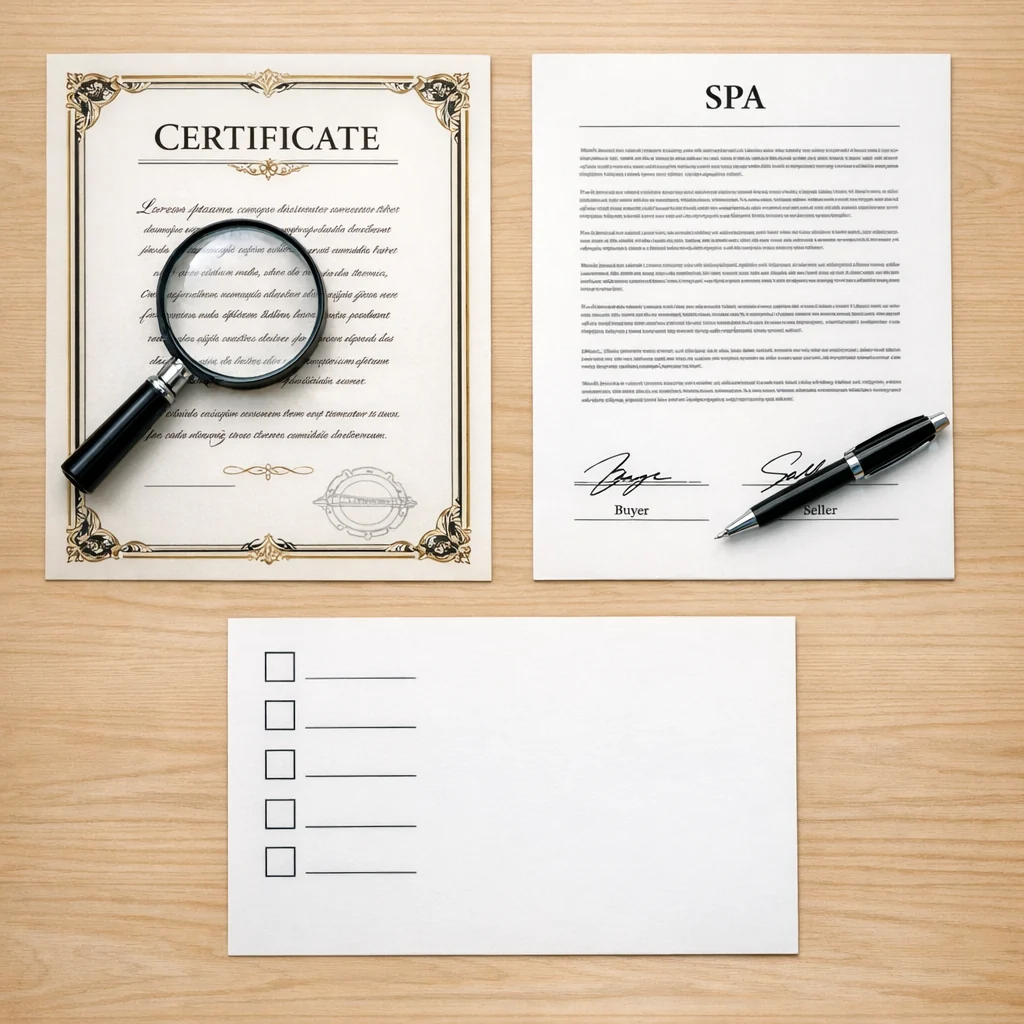
- Ask for the Oqood certificate, not a payment receipt. Sotheby's says it is delivered digitally, by email or portal link, and that a follow-up is appropriate if several weeks pass without one.
- Match every field to the SPA. Unit number, project name, your name as written on your passport, the developer, the price and the payment schedule.
- Confirm the project is registered. The HAS note on Mondaq says buyers can check that a developer has a registered project with the required approvals. A certificate inside an unregistered project is a contradiction worth resolving before you pay further.
- Keep the payment trail in step. Payments should go to the project's escrow account, which the same note describes as part of what the register is meant to enforce. How escrow is released is a separate question, covered in our guide to what the escrow account holds.
- Re-check at handover. Per Sotheby's, Oqood is replaced by the title deed once the property is complete and payments are made. Meraas notes that the DLD offers a Title Deed Verification service for ownership checks.
What Oqood registration does not do
It does not guarantee a handover date. The SPA governs that, and Khaleej Times lists the remedies if a developer is late: compensation as the SPA sets out or a Dubai court orders, a complaint to the DLD, which may attempt conciliation, or a civil claim in the Dubai courts. How late projects actually run is a matter of record, set out in our analysis of delays.
It does not set the price, and it does not say the price is fair. It records the price you agreed. And it is not final ownership. Until the title deed is issued, what you hold is a registered interest in a unit that does not yet exist, which is a strong position when the paperwork is in order and a weak one when it is not.
Of the documents a buyer collects, the certificate is the one issued by the Land Department rather than the seller, which is why it is worth reading line by line.
Abu Dhabi off-plan escrow: when the developer can touch your money
Abu Dhabi off-plan escrow holds buyer money until 20 per cent of the build is complete, with one guarantee-backed exception. Here is how it works.
7 min
Dubai off-plan sales figures: why four reports give four answers
Dubai off-plan sales figures differ by report because scope, resales and single projects change the count. Here is how to read them.
7 min
Put the analysis to work on your own purchase.
An article can only describe the general case. What it means for your objective, your budget and your timeline is a conversation, and the first one costs nothing.
No account and no details to start. Amelia answers first; you share one detail when you want a brochure, a quote, a viewing or your own portal, or to carry on after a long conversation. You will not be added to a calling list. Ever.