
Abu Dhabi off-plan escrow: when the developer can touch your money
Abu Dhabi off-plan escrow works on a simple rule: a developer cannot withdraw a dirham of buyer money until at least 20 per cent of the construction works are complete, as verified by engineers approved by the regulator. There is one narrow exception, and it requires a bank guarantee. Escrowed funds cannot pay for the land or for broker commissions. If a buyer defaults, the developer may keep between 10 and 40 per cent of the contract value, depending on how far the build has progressed.
Those are the rules in force under Abu Dhabi Law No. 2 of 2025 and the administrative decisions that implement it. They matter now because off-plan is where most of the market sits: Savills Middle East, reported by Gulf News, put off-plan at 81 per cent of Abu Dhabi residential transactions in the third quarter of 2026, with an average off-plan price of AED 5 million. At that price, knowing when your money becomes the developer's is not a technicality.
How Abu Dhabi off-plan escrow releases money
Every off-plan project needs its own escrow account with an approved trustee bank. Purchaser instalments, and any project finance proceeds, are paid into it. King & Spalding's summary of the law records that the account cannot fund the land purchase price or broker commissions, only construction, financing payments and other direct completion costs. No withdrawal is allowed until at least 20 per cent of the works are complete, and ADREC-approved engineering consultants verify that figure.
In practical terms, the first fifth of the build is paid for by someone other than the buyer: the developer's own capital or the project's lenders. The buyer's instalments wait.
This is a different design from a milestone schedule that releases money as each stage is certified. Here the first release is a single, high threshold, and what follows depends on the developer's approved schedule and the trustee's checks. A buyer comparing an Abu Dhabi project with one in Dubai is comparing two regimes, each run by its own regulator, and the comparison should be made on the paperwork for each project rather than on the assumption that they match.
The exception: early release against a guarantee
Under Administrative Decision No. 24 of 2025, a developer can apply to ADREC for early disbursement before the 20 per cent mark. A&O Shearman sets out the conditions, all of which must be met:
| Condition | What is required |
|---|---|
| Regulator approval | ADREC approves the application |
| Bank guarantee | Unconditional and irrevocable, for at least 20% of the total construction cost |
| Cost evidence | An approved engineering cost report issued no more than 30 days before the application |
| Track record | Registered in Abu Dhabi for at least four years, and at least three projects completed and delivered on schedule |
| Conduct | No legal violations or administrative penalties in the 12 months before the application |
Delays beyond the developer's control are carved out of the on-schedule test. King & Spalding adds that the guarantee is payable on first written demand, and that it can be returned only at full completion, or earlier once at least 60 per cent of the works are done and a technical report confirms the escrow balance covers what remains.
For a buyer, the exception cuts both ways. Early release is conditional on a delivery record, which rewards the developers a careful buyer would shortlist anyway. It also means the 20 per cent rule is not universal. A project's escrow terms are worth asking about directly.
Where a bank guarantee stops short
A&O Shearman notes that a bank issuing such a guarantee may require the developer to hold equivalent funds or collateral, so the restriction can move to the bank rather than disappear. The guarantee protects the escrow account against a shortfall. It does not protect a buyer against a project that is late, or built to a different standard from the brochure. Those remain matters of record that someone has to watch.
What a buyer forfeits on default
Decision No. 165 of 2025 sets the price of walking away. If a buyer defaults and the unit is cancelled, the developer retains a percentage of the contract value based on construction progress. The figures below are given consistently by A&O Shearman and by BLK Partners on Mondaq.
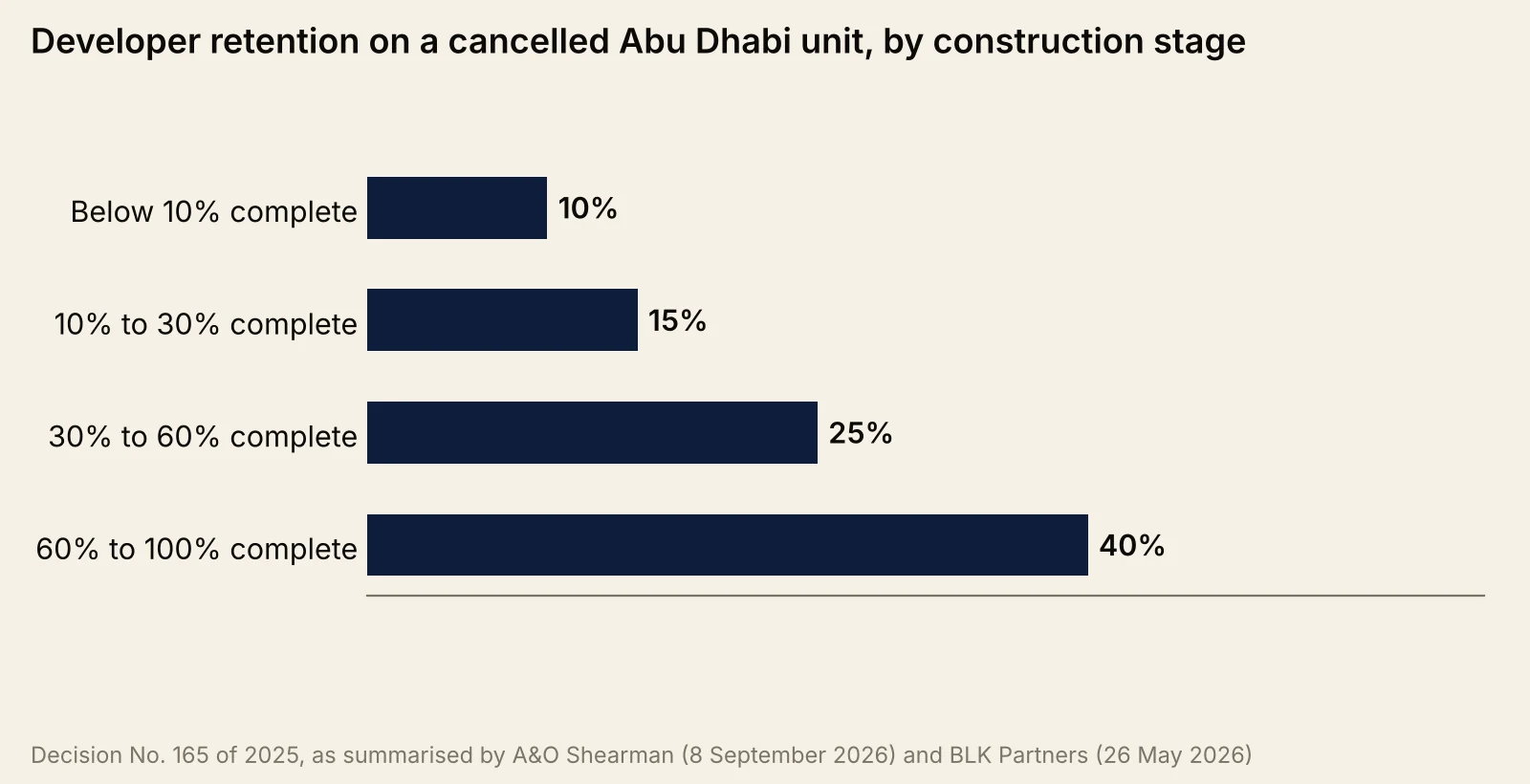
Two further rules sit beside the chart. If the project has not started, for reasons outside the developer's control, the buyer receives a full refund. And where the purchaser has already paid 60 per cent or more of the unit value, ADREC may set the percentage case by case. The published summaries describe the stage bands slightly differently at their boundaries (A&O Shearman says "below 10 per cent", BLK Partners says "up to 10 per cent"), so the decision text is the reference for a unit that sits on a boundary.
A worked example, labelled as our calculation: a buyer with a AED 2,000,000 contract who defaults when the project is 45 per cent complete falls in the 30 to 60 per cent band. The developer retains 25 per cent, which is AED 500,000.
How a default is processed
BLK Partners describes the sequence in Article 17(3) of the amended law. The developer gives 60 days' notice to pay. The Department of Municipalities and Transport facilitates an amicable settlement. If that fails, the developer may terminate, remove the purchaser from the register and resell after 30 days. The purchaser can challenge the termination in court or arbitration.
Refunds follow set timelines. According to A&O Shearman, the escrow trustee pays the developer's deduction within 15 business days of a request on the prescribed ADREC form, and pays the buyer's balance within 15 business days of a request accompanied by a no-objection letter from any mortgagee. Money a developer collected outside escrow must be refunded in full within 30 days of ADREC's cancellation notice, and the developer cannot draw further from escrow until it has been.
Before the money reaches escrow
Expressions of interest are now covered too. Since February 2026, developers launching new off-plan projects must register them through ADREC's Madhmoun platform, and the funds go into a government-managed escrow account supervised by ADREC. The earliest commitment a buyer makes is therefore also ring-fenced.
Questions worth asking about a specific project
- Has the project been registered, and is its escrow account with an approved trustee in place?
- Has the developer applied for early disbursement under Decision 24, and has ADREC approved it?
- Where does the project sit against the 20 per cent mark today, and who verified it?
- If your circumstances change, which retention band would apply, and what would the figure be on your contract?
The rule is strict, and the track-record exception is narrow. Neither tells a buyer whether a particular building will finish on time. That depends on the developer, and the record on that is public to anyone who looks.

Oqood registration in Dubai: what the off-plan register proves and when it starts to count
Oqood registration is the record of your off-plan purchase until the title deed arrives. What it proves, when it begins, and how to check it.
7 min
Dubai off-plan sales figures: why four reports give four answers
Dubai off-plan sales figures differ by report because scope, resales and single projects change the count. Here is how to read them.
7 min
Put the analysis to work on your own purchase.
An article can only describe the general case. What it means for your objective, your budget and your timeline is a conversation, and the first one costs nothing.
No account and no details to start. Amelia answers first; you share one detail when you want a brochure, a quote, a viewing or your own portal, or to carry on after a long conversation. You will not be added to a calling list. Ever.