
What a DLD fee waiver is worth on an off-plan purchase
A full DLD fee waiver is worth 4 per cent of the unit price. On a median off-plan apartment that is roughly AED 77,645, and on a median villa roughly AED 271,655, according to betterhomes' analysis of 2026 median off-plan prices. It is a real saving, paid once, at registration. It is also a developer promotion rather than a government scheme, some waivers are partial, and none of them changes the sale price. That last point is the one buyers tend to miss. A waiver and a price reduction of the same size are different offers, because everything later measured against the price (a valuation, a resale ask, a comparison with the next tower along) still starts from the higher number.
This piece sets out what the fee is, what a waiver covers, why developers reach for it when volumes soften, and how to put a number on it against a discount.
What the 4 per cent actually is
The Dubai Land Department (DLD) charges a registration fee on a sale. For an initial (off-plan) sale, DLD's own service page lists it as two halves: 2 per cent of the sale value from the seller and 2 per cent from the purchaser, plus a knowledge fee and an innovation fee of AED 10 each. In practice the buyer carries the whole 4 per cent. A DLD announcement of 31 May 2021 states that the fee is 4 per cent of the property's value, that the buyer settles it with the developer, and that the developer must pass it to DLD within 60 days.
That routing is why a waiver is possible at all. The developer collects the fee from the buyer and remits it, so the developer can choose to absorb it. The buyer pays less cash at the point of purchase. DLD still receives its revenue.
What a waiver covers, and what it may not
The betterhomes article describes the waiver as covering the DLD registration fee, and says promotions can be full or partial. It does not publish a standard form of words, so the covered items depend on the developer's own terms.
| Item | Covered by a "4% DLD waiver"? |
|---|---|
| DLD registration fee, 4% of the price | Yes, if the waiver is full. A partial waiver covers only part of it |
| Knowledge fee and innovation fee, AED 10 each (DLD fee page) | Not stated by the source. Ask |
| Oqood fee | Not by default. betterhomes lists an Oqood fee waiver for One by Preston only, alongside the DLD waiver |
| Anything not named in the written offer | No. Treat it as payable |
The practical test is the wording in the reservation form or the sale and purchase agreement. A waiver stated as "4 per cent of the sale price" and one stated as "the buyer's 2 per cent share" are worth very different amounts on the same unit.
Why waivers return when volumes fall
Off-plan remains the largest part of Dubai's residential market, but the market around it has cooled. Cavendish Maxwell data reported by The National puts off-plan at 65 per cent of residential sales value and 72 per cent of purchases in the third quarter of 2026, while total sales value fell 47 per cent year on year to AED 72.6 billion and transactions fell 38 per cent to 34,000. The report notes that quarterly data mixes recent and earlier buying, because of the gap between agreeing a purchase and registering it.
A broker release carried by Zawya, issued by Springfield Properties, gives the same quarter in counts: 23,457 off-plan residential transactions against 10,442 in the secondary market. It is a broker's tally rather than a DLD publication, and its own components do not add exactly to its stated total, so use it for proportion, not precision.
The pattern is a familiar one. When fewer buyers are transacting, a developer that does not want to cut headline prices (which would affect every unit already sold and every comparable it is trying to hold) reaches for an incentive that leaves the price list intact. A fee waiver does exactly that. So does a softer payment plan. Betterhomes lists waiver offers across projects from Binghatti, DAMAC, Preston, Imtiaz and Vision in 2026.
Putting a number on a DLD fee waiver
The arithmetic is simple. The table applies 4 per cent to the median off-plan prices in betterhomes' article, which gives no month for them.
| Unit type | Median off-plan price (AED) | 4% DLD fee (AED) |
|---|---|---|
| Apartment | 1,941,130 | 77,645 |
| Villa | 6,791,380 | 271,655 |
Source: betterhomes. Fee figures match 4 per cent of each price.
A waiver against a discount, side by side
The useful comparison is against a straight discount of the same headline size. Take the median apartment. With no incentive the buyer pays the price plus the 4 per cent fee. With a waiver the price is unchanged and the fee is nil. With a 4 per cent discount the price falls, and the fee is then charged on the lower figure.
| Median apartment (AED, our calculation) | No incentive | 4% fee waiver | 4% price discount |
|---|---|---|---|
| Contract price | 1,941,130 | 1,941,130 | 1,863,485 |
| DLD fee at 4% | 77,645 | 0 | 74,539 |
| Total cash to register | 2,018,775 | 1,941,130 | 1,938,024 |
| Saving against no incentive | none | 77,645 | 80,751 |
| Price a lender or later buyer sees | 1,941,130 | 1,941,130 | 1,863,485 |
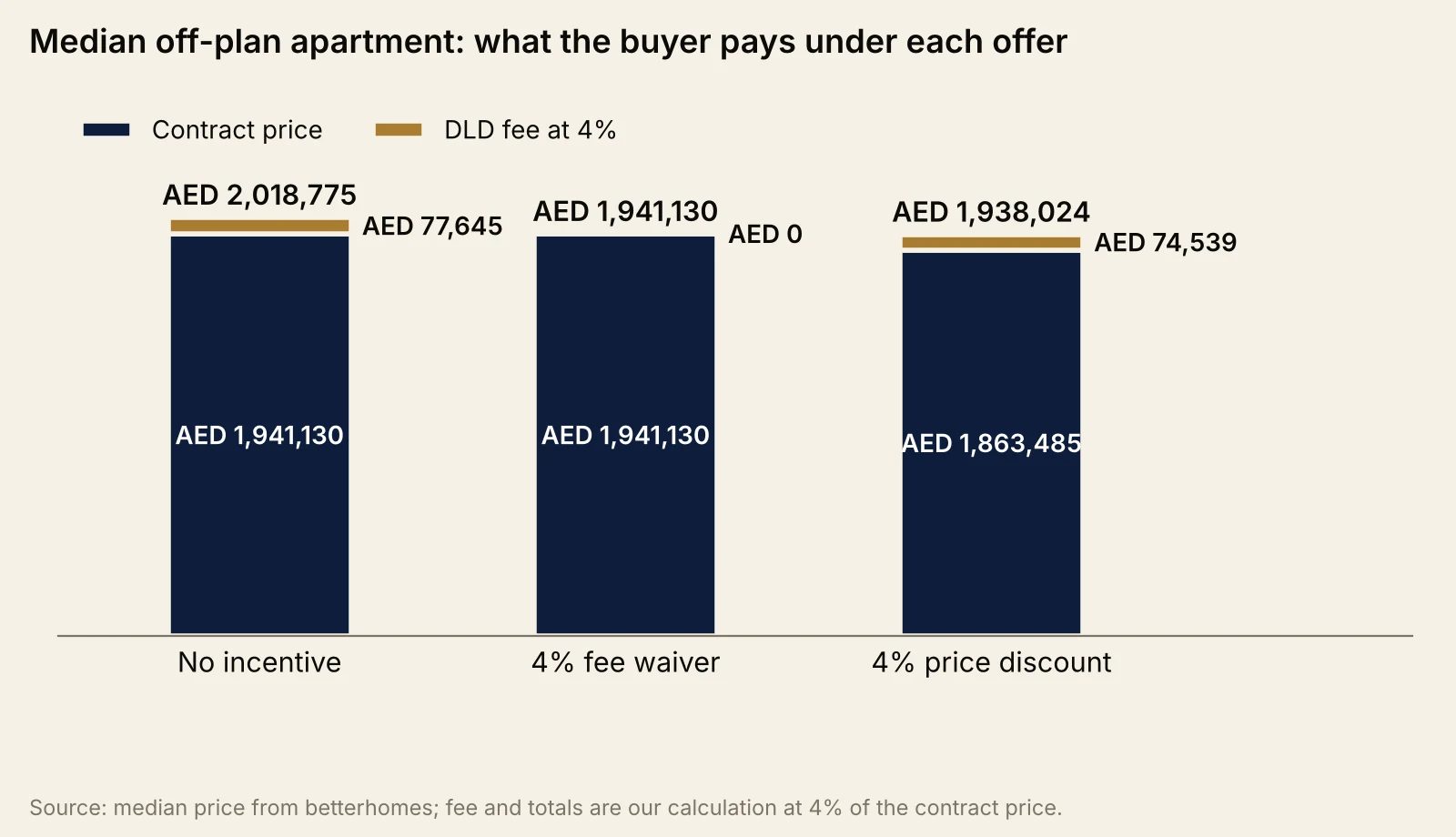
The discount is slightly better in cash, by AED 3,106, because the fee shrinks with the price. The larger difference is the last row of the table. After a discount the unit is on the books at a lower price. After a waiver it is not.
What the waiver does not change
Three things stay anchored to the full price.
The valuation basis. A waiver does not lower the contract price, so any figure derived from it stays where it was. Ask a lender which figure they size the loan against, the price or their own valuation, rather than assuming the saving flows through.
The resale baseline. An investor who later sells is comparing their unit with neighbours that were sold at the list price, with or without a waiver. A buyer who got a discount has a lower cost base to defend. A buyer who got a waiver paid the full price and received a one-off cash saving.
The comparison between developers. A waiver can make a project look cheaper on day one than it is. Two towers with the same payment plan are not equivalent if one comes with a waiver and the other with a better unit price. The only fair test is total cash cost over the life of the plan, which means adding the fee back to any project that does not waive it.
The fine print worth reading
The betterhomes article is a broker's summary, and the developer's own terms are what bind. It notes that a waiver is a developer promotion, so its terms vary by project, unit type and booking window, and that resale properties are generally not eligible. Overseas buyers may qualify depending on the project terms. Promotions can be time-limited and change without notice, and the article recommends getting the waiver amount confirmed in writing.
That last step matters more than it sounds. The waiver should appear in the reservation form or the sale and purchase agreement as a stated amount or a stated percentage, not as a verbal assurance from a sales agent. Ask three things:
- Does the waiver cover the full 4 per cent, or only the buyer's share of a split?
- Are other registration charges, such as the Oqood and knowledge or innovation fees, included or separate?
- What happens to the waiver if the unit is reassigned before handover?
How to weigh it against everything else
A waiver is one line in a larger comparison. The questions that decide whether a project suits a buyer are the developer's delivery record, the payment schedule, the escrow protection and the unit price per square foot against comparable stock. A 4 per cent saving can be wiped out by a premium of the same size in the price per square foot, or by a payment plan that front-loads cash the buyer would rather keep.
A reasonable rule is to convert every incentive into the same unit before comparing. Express the waiver as a percentage of price, express any price difference as a percentage, and add them. If one project is 3 per cent dearer per square foot but waives the fee, the net is a 1 per cent saving, which is too small to outweigh a weaker delivery record.
That is also where cross-developer comparison earns its keep. Incentives are designed to be compared inside one developer's brochure. They have to be compared across several to mean anything.

Oqood registration in Dubai: what the off-plan register proves and when it starts to count
Oqood registration is the record of your off-plan purchase until the title deed arrives. What it proves, when it begins, and how to check it.
7 min
Abu Dhabi off-plan escrow: when the developer can touch your money
Abu Dhabi off-plan escrow holds buyer money until 20 per cent of the build is complete, with one guarantee-backed exception. Here is how it works.
7 min
Put the analysis to work on your own purchase.
An article can only describe the general case. What it means for your objective, your budget and your timeline is a conversation, and the first one costs nothing.
No account and no details to start. Amelia answers first; you share one detail when you want a brochure, a quote, a viewing or your own portal, or to carry on after a long conversation. You will not be added to a calling list. Ever.